Landing at the nexus of my origin story and my legacy
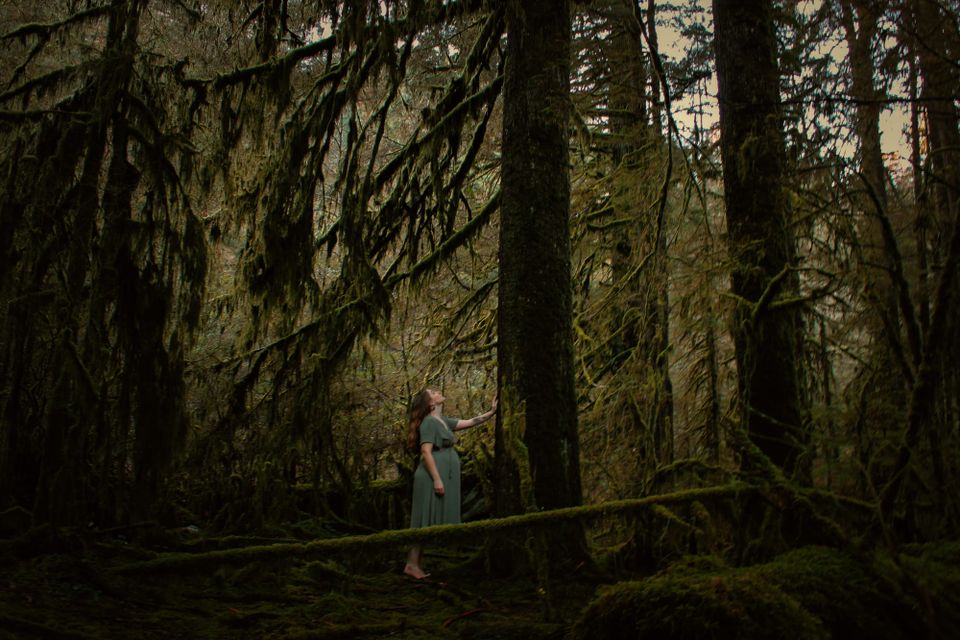
My childhood was shaped by growing up in a small town on the prairies, camping and cabin vacations, and living a comfortable middle-class life. It was also shadowed by traumatic experiences that led me to believe I was both not enough and too much, and that I did not belong or deserve love. These experiences would manifest in varying impacts on my body, mind, heart, and spirit. These views would also eventually shift, upon finding communities who nurtured my sense of belonging, and kindling my engagement with belonging in what adrienne maree brown calls fractals–repetitive patterns of transformation from the individual to the collective in reflection of and in relationship with nature. Effectively, healing myself (individual) comes alongside my relationship with community and the land (collective), which feeds my curiousity of how we may all live in community with the land for our mutual healing. This requires knowing myself, so I will start at the beginning.
The names my parents gave me upon my birth are Teresa Rosanne Van Den Bosch. While I go by Tess, I was named after my maternal grandmother, Teresa, which is derived from Greek θερίζω (therízō) meaning “to harvest”. Rosanne, also from family names, is a compound of Rose (derived from Latin rosa) for the flower of the same name, and Anne, rooted in Hebrew חָנַן (ḥanan) meaning "to be gracious" (Behind the Name, 2021, 2022, 2024). Finally, Van Den Bosch comes from my Belgian father and means “from the woods” in Flemish. My name, therefore, means “harvester of gracious roses from the woods”, and represents a relationship with my ancestors and the earth. I am of the earth.
I am also of the lands we now call Canada. While born and raised on Treaty 2 territory in southwestern Manitoba–home of the Anishinaabe, Cree, and Dene Peoples, the unceded territory of the Dakota, and the homelands of the Red River Métis, I now live in Calgary with my husband, daughter, and dog, on Treaty 7 territory–the traditional lands of the Blackfoot Confederacy, the Tsuu’tina Nation (neighbouring my home), the Îethka Stoney Nakoda Nations, and home to Métis Nation of Alberta Districts 5 and 6. I am mindful that land acknowledgements can be devoid of substance when meant to satisfy settler guilt or check a box, which consequently perpetuates settler-colonial harm; however, they personally hold great meaning for me.
Land acknowledgements started to become more standard practice during my undergraduate degree at Toronto Metropolitan University after the release of the Truth & Reconciliation Commission’s 94 Calls to Action in 2015. Alongside my studies, land acknowledgements provoked me to think more deeply about my relationship with the Indigenous people of these lands (whom I knew little about and am still learning), my relationship with the land itself, and how I arrived here. My ancestral roots span across the ocean from Ireland, England, and Belgium. Thanks to family historians like my Taunta Rosa, one of my namesakes, and Great Uncle Peter Hennessy, a historian and scholar who taught at Queen’s University, I know some of my ancestors felt pushed by the ravages of World War I and the American Revolutionary War, some settled in New England first in the early colonies, some possibly migrated as indentured servants; but almost all arrived here for ‘free’ or ‘cheap’ land as farmers. Not only am I Teresa the harvester, but my ancestors were harvesters, too. My people are of the earth.
They were also agents of colonization, and their arrival on these lands made me a white settler. What does this inheritance mean in view of the incredible harms of the settler-colonialism that made me of these lands? What does it mean to belong to these lands as a settler and what responsibility does that hold? While the answers swirl in continuous crystallization, research and writing provide fertile ground to engage with my European settler ancestral inheritance, and reflexively use my privilege and power. Research is reconciliation, as Dr. Shawn Wilson teaches us, and how I move beyond the land acknowledgement into responsibly living decolonization and reconciliation.
This is no solitary movement, either. I am not “from the woods” alone, but part of a diverse forest nourished through a vast and inextricably intertwined root system. The communities I live and grow with are the trees, plants, soil, rocks, and animals, and are all rooted in the teachings, blessings, and guidance from many on my path, including those I have known well, met once, or never been acquainted with personally: my family (including my parents, grandparents, husband, and dog, Dash), Elder Clarence Wolfleg, Elder Marilyn Shingoose, Colleen Charles, Mike Byerley, Dr. Jebunessa Chapola, Stephanie Foo, Robin Wall Kimmerer, Joanna Macy, Asia Suler, Tara Brading, adrienne maree brown, and Vandana Shiva, and so so so many more. Lastly, and importantly, my daughter, the one I carry in my belly in the photo above, is also one of my greatest teachers, for children show us each day how important it is we stand up to the forceful constructs of settler-colonialism. Collectively, these teachers, amongst many others, have influenced or expanded my understanding of relationships with the land and more-than-human world, decolonization, and reconciliation, and how important it is to tenderly endeavour to shift the origin story for future generations.
Re-learning and disrupting my colonized mind has been especially enriched while working towards my Master of Arts in Community Development (MACD) at the University of Victoria, particularly in the Indigenous Research Methods course where I first wrote the contents of this blog post for an assignment where we were lovingly asked to locate ourselves. When my supervisor, Dr. Heather Castledan, first shared the opportunity, I was both excited and reluctant. Was it appropriate for me, a settler, to take up space in this class? Am I allowed to do Indigenous research? Will I be appropriating knowledge? After the very first class I was grateful for Heather’s guidance, for my teacher, Edōsdi, has fundamentally changed how I see research and knowledge through lessons about Indigenist research and what Adam Gaudry calls “insurgent research for everyone”. Edōsdi also actively fostered relationships for her students with Indigenous research and researchers, and Indigenous research is built on such relationships. She made a safe space for respectful dialogue and asking the uncomfortable questions, and has now become part of my root system. After one class I wrote a short poem as an ode to this learning:
Humbly grateful for Indigenous teachings.
I am swirling in the whirling.
Grateful for safe space for settler unpacking.
I welcome the storm.
These teachings are vital, for while my research interests are emergent and evolving, they always involve settler responsibility, Indigenous-settler relations, ancestral memory, and relationships with the land and the more-than-human world with a focus on relational, creative, and action-oriented research that disrupts the settler-colonial paradigm for socioecological transformation. I believe Indigenous research is disrupting this paradigm in a big and beautiful way. For example, through the lens Dr. Shawn Wilson offers I see knowledge is not something I have and generate, but something I have and generate a relationship with, and through which I enact relational accountability. That is, by building and honouring relationships with knowledge, research, and communities, I live respectfully and accountably to those relationships.
There is no greater joy than to do this through research, writing, storytelling, and shared community experience. It is my bliss! Years ago, in search of a meaningful life, my dear friend and colleague at Tapestry Collective Co-op, Robyn McLean, advised me to follow my bliss. My roommate at the time also shared this advice commonly quoted from Howard Thurman: “Don't ask what the world needs. Ask what makes you come alive, and go do that. Because what the world needs is people who have come alive”. So here I am! While I live with chronic pain that has accelerated in the past year, I have never felt more grounded and enlivened, because I recognize that my bliss–what makes me come alive–is relationships: with the land, the more-than-human world, and each other; and the power of love and knowledge to nourish and transform these relationships. I finally know what it feels like not just to want to do this work, but to know I must do this work, for it is how I make my settler responsibility come alive.
I have learned that I can build on my bliss by continually pushing beyond the boundaries of my own worldview, connecting with others in this healing work, and nurturing a new just and relational paradigm with our human and more-than-human kin. As Tess, the harvester of gracious roses from the woods, I humbly hold myself to this responsibility, for I not only want to harvest from the woods, but I want to honour the roses and give back to the woods. Robin Wall Kimmerer, renowned Potawatomi scientist and author, asks us, “Isn’t this the purpose of education, to learn the nature of your own gifts and how to use them for good in the world?”. Writing and research conducted and shared in a good way are some of the gifts I can give; are the love and legacy I can leave my daughter and all our future human and more-than-human children.
This blog post drew teachings and knowledge specifically from:
- Bailie, G. (1995). Violence unveiled: Humanity at the crossroads. Crossroad Publishing Company.
- Behind the Name. (2021, April 25). Teresa — Meaning, origin and history of the name. Retrieved February 9, 2026, from https://www.behindthename.com/name/teresa
- Behind the Name. (2022, December 7). Rose — Meaning, origin and history of the name. Retrieved February 9, 2026, from https://www.behindthename.com/name/rose
- Behind the Name. (2024, April 23). Anne — Meaning, origin and history of the name. Retrieved February 9, 2026, from https://www.behindthename.com/name/anne-1
- Breen, A. V. (2019). You do not belong here: Storying allyship in an ugly sweater. In S. Wilson, A. V. Breen, & L. DuPré (Eds.), Research and reconciliation: Unsettling ways of knowing through Indigenous relationships (pp. 49–59). Canadian Scholars.
- brown, a. m. (2017). Emergent strategy: Shaping change, changing worlds. AK Press.
- Gaudry, A. J. (2015). Researching the resurgence: Insurgent research and community-engaged methodologies in 21st-century academic inquiry. In S. Strega & L. A. Brown (Eds.), Research as resistance: Revisiting critical, Indigenous, and anti-oppressive approaches (2nd ed., pp. 243–265). Canadian Scholars’ Press.
- Hennessy, P. H. (1991). The Hennessys of the Bay of Quinte. P. H. Hennessy.
- Kimmerer, R. W. (2013). Braiding sweetgrass: Indigenous wisdom, scientific knowledge, and the teachings of plants. Milkweed Editions.
- Kovach, M. (2009). Indigenous methodologies: Characteristics, conversations, and contexts. University of Toronto Press.
- Mosselson, J. (2010). Subjectivity and reflexivity: Locating the self in research on dislocation. International Journal of Qualitative Studies in Education, 23(4), 479–494. https://doi.org/10.1080/09518398.2010.492771
- Ryan-York, C. (2025). “As Long as the Grass Grows, and the Sun Walks”: Finding Discomfort in Land Acknowledgements. Spectrum (Edmonton, Alta. : 2018), 14. https://doi.org/10.29173/spectrum242
- Wark, J. (2021). Land acknowledgements in the academy: Refusing the settler myth. Curriculum Inquiry, 51(2), 191–209. https://doi.org/10.1080/03626784.2021.1889924
- Wilson, S., & Hughes, M. (2019). Why research is reconciliation. In S. Wilson, A. V. Breen, & L. DuPré (Eds.), Research and reconciliation: Unsettling ways of knowing through Indigenous relationships (pp. 5–19). Canadian Scholars.